

City gains control of Schott Building

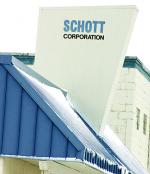
Hailed as an important step for the Minneota community was last week’s announcement that ADOM (Area Development of Minneota) would now be in charge of the “Schott Building” in Minneota.
“It’s going to be a benefit to the community in general,” said Brad Minnehan, a member of the ADOM board.
“We have a lot more options to put someone in there,” Minnehan added.
The building has basically sat empty since 2003 when the Schott stopped doing business.
The Schott Corporation manufactured magnetic components and other technical devices, mostly for the computer industry during its successful run from 1974 to 2003.
“We stopped doing business and have been trying to find someone to come into town,” said Owen Schott.
It’s a huge building, and although there have been numerous inquiries to use the facility, Schott found, “It was too big. People don’t need this much space.”
“Owen tried (to fill the building). There’s no question about it,” said Bill Ufkin, also a member of ADOM.
“He has been trying to get a use for the building for a long time. Hopefully it gives us more options,” said Ufkin.
Schott’s latest idea was to transform the building into a housing development.
“Most recently we thought it was possible to put it into a housing complex,” said Schott. “There was an opportunity for rental units,” he said.
But after reviewing proposals with architects, it was determined it would be too difficult to turn the building into a housing complex.
“We considered tearing it down but that would be quite expensive and I didn’t feel we could afford that,” said Owen Schott.
Instead, he decided to turn the building over to the city and last Friday he pulled a folder out of his briefcase labeled “keys” and turned the keys to the building over to the City of Minneota.
“Congratulations! You have a building,” Schott said, as he smiled and turned over the keys.
City Administrator Shirley Teigland has been in contact with Owen since she got the job as city administrator.
“She was the one who developed a relationship with Owen. About two or three years ago when I was mayor, she brought Owen and I together with her and we talked about things,” said Ufkin.
At that time, he was hoping to get a business to move into the building.
“Now this is been going on for about a month or so. Shirley talked with her consultants and then contacted ADOM,” said Ufkin.
With ADOM controlling the building, “It gives us a lot more options on how to finance the building down the road,” said Ufkin.
“I’m glad we got this done. Everyone on the board has been very supportive but the credit should go with Shirley and to Owen for deciding to donate the building,” Ufkin added.
“Teigland looked at all the options from the city’s point of view and Owen’s giving it to a non-profit organization gives us more options. This gave the city the most flexibility. I’m really glad we got this done,” Ufkin added.
Originally the building was the Kerr Hatchery.
“The Minneota Community Development Group bought the building from Kerr Hatchery. That was a big business in its day, when lots of people raised chickens.”
The community pulled money together and the local bank helped to secure the building.
“Veterinarian Doc Kerr convinced Ottertail to bring power into the town as a backup. In the late ‘60’s, Doc Pennings bought the hatchery. The development corporation bought it from him. Credit to Owen and Shirley. They got this process started.”
“Obviously we’re going to try and find business over there if at all possible,” Ufkin added.
Kevin Anundson, an ADOM board member said, “Now there is potential for change to a purpose that can be used. It all remains to be seen. But we’ll give it two years (to get a business in the building).”
Anundson said the building is in good shape and won’t need a lot of repair.
“This just gives us more options,” he added.
“Obviously if we can get a business in there that would be really good,” added Ufkin.
“If we can’t find business in a certain number of years the EDA (Economic Development Administration of Minneota) is going to take it on. Without the EDA, we would not have been able to do this,” Ufkin said.
The EDA’s willingness to help in the future was a big factor in ADOM taking on the project.
“Demolition costs are incredible. That would be the worst case,” said Ufkin.
“It looks like a good thing now and we hope it brings economic opportunity to the community,” Ufkin added.
“Now we have a lot more options to put someone in there,” added Minnehan. “With the building in our possession, we can explore more options and see what interest is out there,” said Minnehan.
“We’re not going to be in a hurry. We want to see something in there but we’re not in a rush to fill it,” he said.
The fact the property is now in the hands of the city is seen as a major benefit. “The property will be a benefit to the city,” Minnehan said. “Our group can definitely see potential. It’s going to be fun to see where it takes us,” he added.
“It’s good Owen was willing to give it back to the community. After all, the community bent over backwards to help when he came to town,” Minnehan said.