

Brother’s not missing anymore


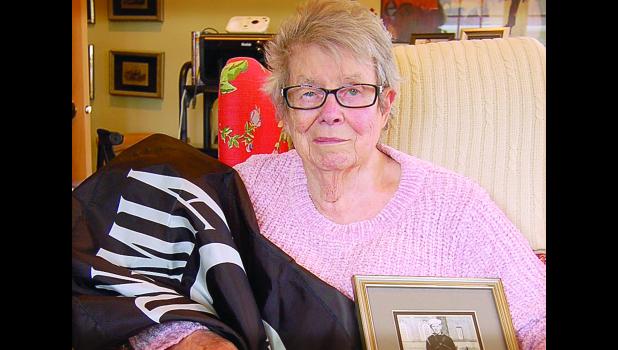
Elaine Johnson finally has the answer she has been waiting 75 years for.
But the length of time that has passed didn't make the news any easier to take.
On this past Veterans Day, it was revealed that the U.S.S. Grayback submarine that Johnson's brother, Minneota native Earl Eugene Halvorson, and 79 other crew members were aboard had been discovered sunk in 1,400 feet of water off the coast of Japan.
Halvorson, Seaman First Class, and the his others were declared missing in action during World War II in 1944 and presumed dead two years after that.
"My mother (Amelia Halvorson) and I never believed he was dead," said Johnson, who lives in Marshall. "We wouldn't accept that. We were afraid he was captured by the Russians."
For 75 years, the Grayback's whereabouts remained a mystery. Until now.
"When they found the Grayback, I don't know if I teared up more because it was found or because of mom," said Elaine's daughter, Deborah Anderson.
Elaine's son, Tom, was visiting his mother from his home in Athens, GA, the day the news was reported to them via a phone call.
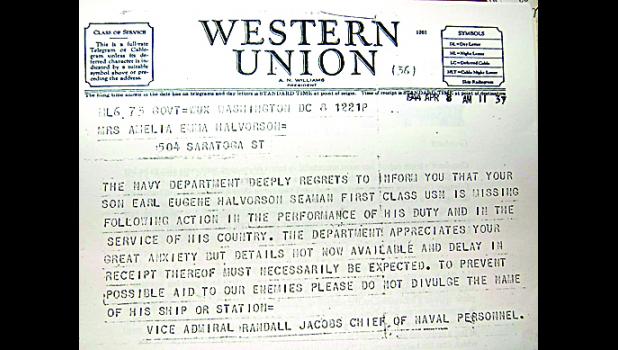
"Even after a few days, I still feel shaky inside," said Elaine, her voice trembling as she spoke. "It's very easy for me to cry now. I find a little comfort knowing he wasn't alone when he died. But it's still hard to deal with." Amelia's husband, Johnnie, passed away in 1932, leaving her to receive the news of their son missing in action via a Western Union telegram from the war department dated April 8, 1944.
"My sister, Eunnie (Eunice) and I were out selling papers for the Girl Scouts that day," Elaine recalls. "When we got home, mom was crying and told us the news. We were all in shock."
And then a second Western Union telegram arrived on Feb. 19, 1946 from Vice Admiral A.S. Carpenter of the Ninth Naval District in Great Lakes, IL, regretfully informing the family that Earl and the others aboard the U.S.S. Grayback were presumed dead.
"The grief my mother went through for the rest of her life was awful," Elaine said. "She was just devastated. And it made it hard on all of us to see her that way."
Elaine was one of five children to Amelia and Johnnie Halvorson. All five siblings' names began with the letter "E"; Elvira, Earl, Ervin, Elaine and Eunice.
Johnnie was only 34 years old when he died, leaving Amelia to raise the children alone on a farm five miles south and 21/2 miles west of Minneota.
Amelia eventually moved the family to Marshall.
After the news to confirm the sinking of the Grayback, and that Earl and the 79 other crew members are entombed inside the submarine, Elaine, 90, is now the only one of her siblings still alive.
"I was 13 years old when Earl went off to war (in 1942)," said Elaine with tears welling in her eyes. "He was only 17 years old. And we never saw him again."
"Because Earl was only 17, my mother had to sign for him to go into the Navy. She said she would never forgive herself if anything happened to him. I will always remember her saying that, and it makes it so hard to think about."
Once the Grayback went missing, Amelia began tracking down as many of the other 79 families of the missing young men aboard the Grayback and corresponding with them.
"My mother kept a scrapbook of the letters and pictures that were sent to her by the other families," said Elaine.
As far as family can tell, 44 of the other 79 families corresponded with Amelia.
The meticulously-made scrapbook, along with many other articles and items Amelia had obtained, eventually became the possession of Ervin Halvorson, Earl's younger brother, after Amelia passed away.
When Ervin passed away, his daughter Diane Wilson and granddaughter Amy Cunningham are now in possession of the scrapbooks.
Amy Cunningham, an artist living in Princeton, finished a large painting of Earl two years ago. In it, Halvorson is in his Navy uniform with a real post-office box inserted in his hands. The box can be actually be opened to reveal a copy of a letter he once wrote home to his mother, as well as a duplicate "lucky" coin he had given to his brother Ervin when he left for the war.
Ervin initially joined the U.S. Navy later with the sole purpose of trying to find his missing brother.
The Purple Heart Earl's family received is now proudly displayed on a wall at his nephew Tom Halvorson's home in Georgia.
The U.S.S. Grayback, ranked as one of the most successful U.S. submarines in World War II, was discovered off the coast of Okinawa by explorer Tim Taylor and his team's Lost 52 Project on June 5, but the discovery wasn't made public until Veteran's Day this year in order for Taylor and his wife Christine Dennison could locate as many of the 80 families as possible.
The Lost 52 Project's goal is to find as many of the 52 U.S. submarines that went missing in WWII. To date, five have now been discovered.
The Grayback sailed out of Pearl Harbor in Jan. 1944 and headed for the South China Sea on its 10th patrol. On Feb. 19, the Grayback radioed that she had sunk two enemy cargo ships and damaged two others.
On Feb. 25, the Grayback reported she has sunk a tanker and severely damaged another.
With only two torpedoes remaining, the Grayback was ordered to return home from patrol and expected to reach Midway on March 7.
According to Japanese records, the Grayback used its final two torpedoes to sink a freighter and was then spotted on the surface in the East China Sea by a Japanese bomber pilot. The pilot dropped a 500-pound bomb on the Grayback, hitting the conning tower. The submarined exploded and immediately sunk, the pilot's record indicated. An anti-submarine craft was then called in to set off depth charges until an oil slick eventually swelled to the surface.
"From what we have read and been told, the Grayback was low on battery, was out of torpedoes and the radar was malfunctioning," said Tom Halvorson. "So it was running on the surface to recharge when it was spotted."
It wasn't until recently that amateur researcher Yutaka Iwasaki discovered an error had been made by the U.S. Navy in translating the coordinates of Japanese military documents.
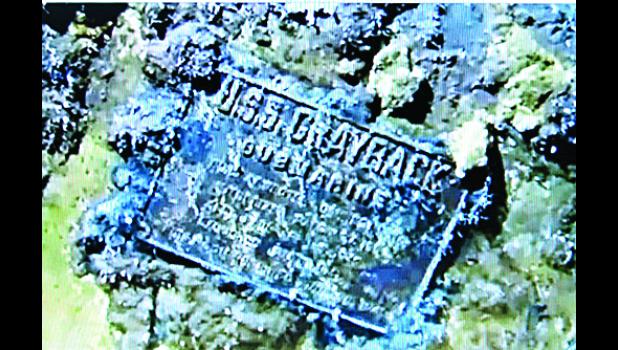
Project 52 crew members utilized drone cameras to read the name of the Grayback on a plaque affixed to the sunken submarine.
Upon receiving the telegram in 1946 of Earl's presumed death from the U.S. Navy, the family held a funeral ceremony and a headstone was placed in Hemnes Cemetery south of Minneota. The inscription lists the date of his death as Jan. 12, 1946, but that date will likely be changed by the family to more accurately reflect the correct date according to recent information that has been discovered.
Elaine's husband, Howard, passed away on 2010. They had four children: Thomas, Deborah, Robert and John. Elaine also has two grandchildren and three great-grandchildren.
A paver for Earl Halvorson, purchased several years ago by Elaine and Eunice, also rests in Veteran's Park in Minneota.
The family still has one more thing they want to find out relating to Earl.
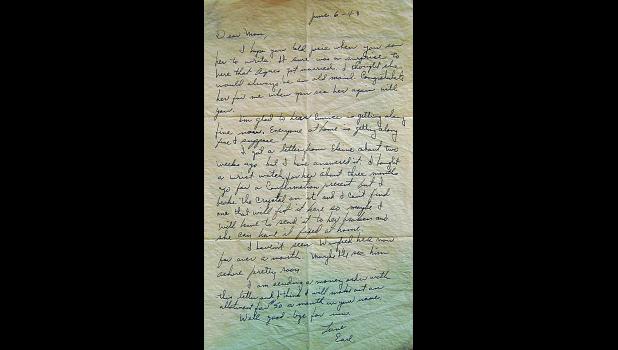
On June 6, 1943, Earl wrote a letter to his mother, informing her that he had bought a wrist watch three months earlier for his sister Elaine for her confirmation. He told that he had not sent the watch home because he had broken the crystal on it and had not yet found one to replace it with.
But Earl never returned to Hawaii from the Grayback's 10th mission and the family has begun a search for the watch.
"Earl supposedly took the watch to a jewelry store in Hawaii to have it fixed," said Tom. "We don't know if the watch is even still around, but we're not giving up hope either."
On Memorial Day each year, Elaine has displayed an American flag and a black Prisoner of War/Missing in Action (POW/MIA) flag on her front door.
Elaine took out the black flag and while clutching it, the MIA letters were visible near her right shoulder.
"I guess I don't need to put this up anymore," she said, sobbing. "My Earl's not missing anymore."